


Silicone Collagen Sheets
Silicone Collagen Sheets



Say goodbye to scar creams that sit on the surface. The 100% medical-grade silicone sheet dermatologists have recommended since 1981 — now available at home. Works overnight to lock in moisture, regulate collagen, and flatten raised scars in 4–6 weeks.
⚡ Rakhi Special sale is live ⚡
Offer Ends Tonight
Couldn't load pickup availability
Want it by ? ORDER WITHIN

What is medical-grade silicone?
What is medical-grade silicone?
Medical-grade: same silicone trusted in surgical and post-op care
100% pure: no chemicals, fragrances, dyes, or latex
PTFE-free: no harsh synthetic additives
How it works: creates a microclimate — moisture stays in, collagen rebalances
Best for: raised, hypertrophic, keloid scars + fine lines from repeated expressions
Which scars does it actually work on?
Which scars does it actually work on?
Best results: raised scars, keloids, hypertrophic scars, C-section scars
Also effective: acne scar texture (raised), stretch marks, surgical scars
Fine lines: smooths and softens overnight — especially sleep-crease areas
Honest note: pitted/indented acne scars need different treatment — sheets work on raised tissue
Timeline: visible softening in 2–3 weeks. Significant fading in 4–6 weeks.
How is this different from scar creams?
How is this different from scar creams?
Creams: sit on skin surface, can't change scar tissue structure
Silicone sheets: create an occlusive seal directly on the scar
Mechanism: locks moisture in, signals collagen to self-regulate
Clinical use: first-line dermatologist recommendation since 1981
Result: scar flattens from within — not just covered up
How do I use it?
How do I use it?
Prep: Wash and dry skin completely — no moisturiser, no oil, no serum underneath
Cut: Trim sheet to match your scar or target area — any size, any shape
Apply: Peel liner, press adhesive side firmly onto dry skin
Wear: Leave on 6–8 hours overnight. Reattach liner to store. Reuse up to 7 times.
Return Policy
Return Policy
We offer a 30-day return policy for unused and unopened products. If you are not satisfied with your purchase, please contact our customer service team to initiate a return.



Real Skin. Real Scars. Real Science Behind It.


From Raised and Dark to Flat, Soft, and Faded


Tri-Pathway Brightening — Visible at Week 8
Arbutin 7% blocks tyrosinase — the enzyme that converts amino acids into melanin. Tranexamic Acid cuts the UV-induced signal that overactivates melanocytes. Together they address both the trigger and the production — which is why results don't just surface and then stall the way single-active products do.


The Science
How Silicone Collagen Sheets Works
STEP 01
Seal:
The sheet creates an occlusive barrier directly on the scar surface. No air, no moisture loss — a sealed microclimate forms between the silicone and your skin.
STEP 02
Hydrate:
Trapped moisture raises the hydration level of the stratum corneum. Fibroblasts — the cells responsible for collagen production — respond to this hydration signal and begin to self-regulate.
STEP 03
Regulate:
Overactive collagen production in raised scars slows down. Existing collagen fibres reorganise from chaotic, cross-linked scar tissue into more normal, flat, aligned tissue.
STEP 04
Remodel:
Over weeks, scar tissue flattens, softens, and fades. Skin tone at the scar site begins to normalise. Fine lines stay smooth because overnight creasing is physically prevented.
WHAT IT'S MADE OF
One ingredient. No compromise. Exactly what dermatologists use.

Clinical
Same silicone your surgeon uses. Seals the scar, locks moisture in, tells collagen to stop overproducing.

Hydrating
Traps overnight moisture. Fine lines plump. Scar tissue softens and remodels.

Secure
Flexes with skin all night. No peeling, no residue, no redness.
YOUR JOURNEY WITH US!
Your Journey With the Silicone Collagen Sheets

Skin Feels Different
The scar softens slightly to the touch. Fine lines look smoother the morning after first use. The overnight hydration effect is immediate — collagen remodelling takes longer.
Raised Scars Start Flattening
The scar sits lower. Itching or discomfort associated with keloids and hypertrophic scars reduces noticeably. The skin around the scar looks more even.
Colour Begins to Match
Scar tissue lightens toward your natural skin tone. Fine lines are visibly less defined in the morning even before makeup. Consistency is working.
Significant Visual Change
Most users report their scar is no longer the first thing they see in the mirror. Raised tissue is substantially flatter. Colour has faded significantly. Life changes — confidence in what you wear returns
A New Baseline
For many scars, this is the point of maintenance. The collagen has remodelled. The scar is flat, skin-tone-matched, and no longer symptomatic. Some scars continue improving beyond 6 months.

Silicone Collagen Sheets that work the way science intended.
🔬 Medical-Grade. Clinically Backed- The same silicone used in post-surgical wound care — dermatologist first-line since 1981. No cream comes close.
🌙 Overnight. While You Sleep- Apply, press, sleep. 8 hours of silicone contact — moisture locks in, collagen rebalances. No effort required.
✂️ Cut to Any Scar. Any Size- C-section strip, forehead rectangle, keloid patch — one roll covers every scar on your body.
🇮🇳 Built for Indian Skin- Darker skin is significantly more keloid-prone. This addresses raised scar tissue at the source, safe for all Indian skin tones.
♻️ Reusable. Cost-Effective- Up to 7 uses per strip. Laser sessions cost ₹3,000–₹15,000 each. This doesn't.

USE WITHOUT ANY WORRIES
Highly Recommended By Dermatologists
Yelena Terushkin, a licensed Dermatologist in both New York and Florida, specializes in medical, surgical, and cosmetic dermatology. "I recommend Velora Beauty Silicone Sheets for everyone, patients with acne scars or wrinkles and fine lines. They deliver real results because they regulate collagen production and smooth the skin naturally."
See it in action


Frequently Asked Questions
Silicone sheets work best on raised scars — C-section scars, keloids, hypertrophic scars, raised acne scars, surgical scars, stretch marks, and burn scars. They also soften and smooth fine lines and sleep creases. Honest note: pitted or indented acne scars (the sunken kind) need a different treatment — silicone works on tissue that is raised, not tissue that is sunken.
For fine lines: most people notice smoother skin the morning after first use. For raised scars: expect visible softening within 2–3 weeks, and significant improvement in scar colour and height after 4–6 weeks of consistent nightly use. Older or larger scars may take longer — give it 3 months.
The most common reason is skin that isn't fully dry. Any residue of moisturiser, oil, or serum on the skin reduces adhesion dramatically. The fix: wash the area, then dry completely — a hair dryer on low for 30 seconds is the trick most people miss. Press the sheet firmly along the full surface when applying. Our sheets use a medical-grade adhesive designed to flex with skin movement through the night.
No. Pure medical-grade silicone contains no pore-clogging ingredients — no waxes, no occlusive creams, no actives. It forms a breathable barrier that retains moisture without trapping bacteria. Thousands of acne-prone users wear these on their face overnight without a single breakout reported in our panel.
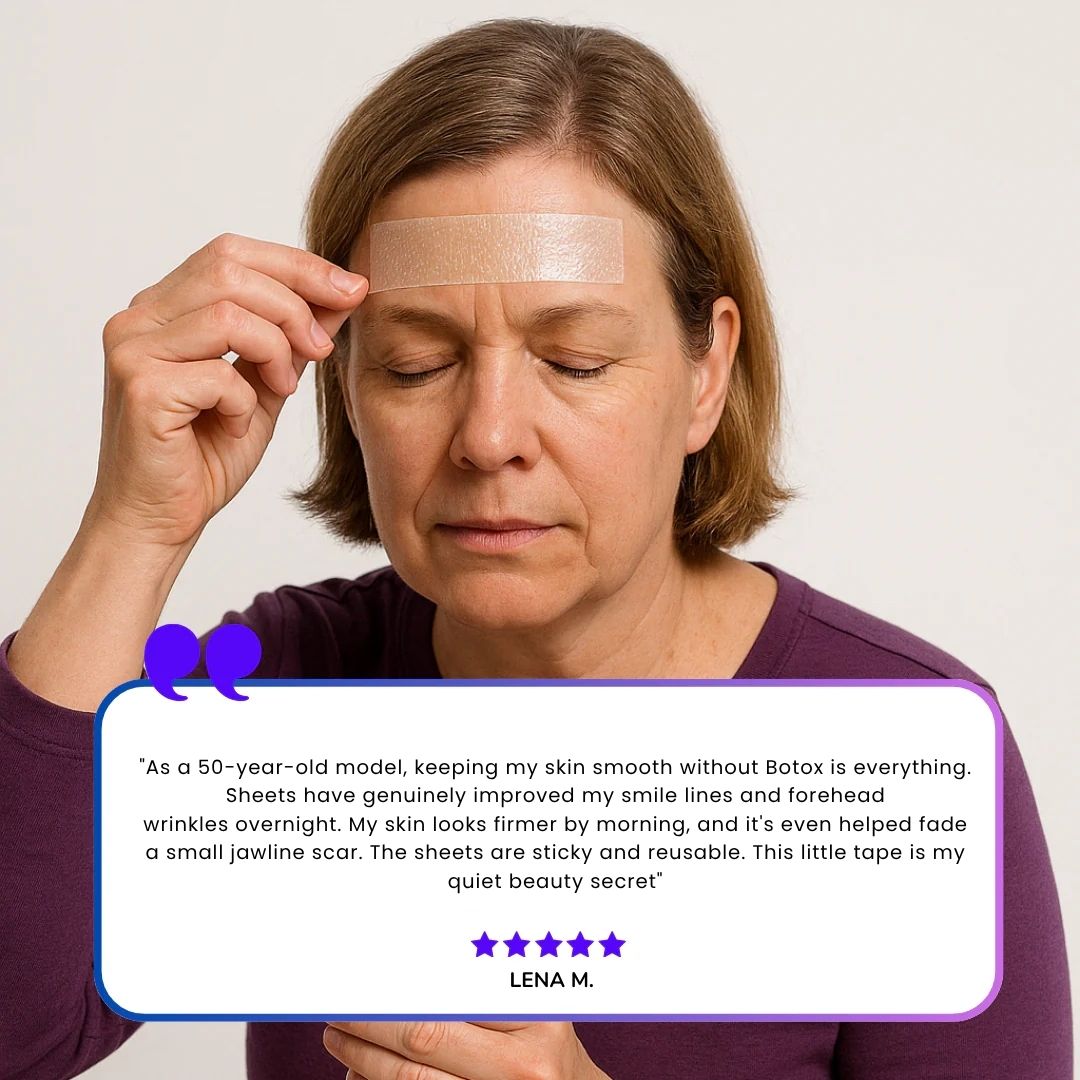
Cut a narrow horizontal strip for forehead lines. Cut a small V or rectangle for 11-lines between the brows. Apply to clean, completely dry skin at bedtime. The sheet prevents skin from folding and creasing as you sleep — the main cause of expression lines deepening. Use nightly for best results.
After each use, reattach the liner to preserve stickiness. Every 2–3 uses, wash gently with mild antibacterial soap and lukewarm water. Pat dry completely — do not rub. If adhesion reduces after washing, a hair dryer on low for 20 seconds restores stickiness. Each sheet is reusable up to 7 times.